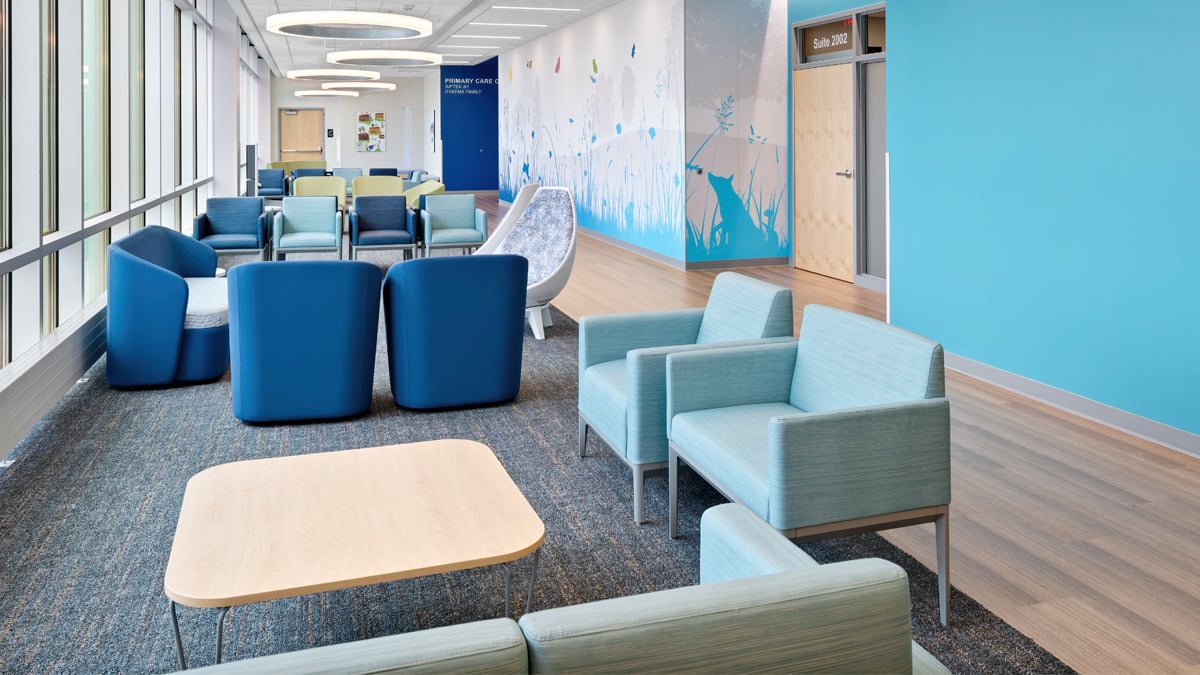
As more care happens seated, thoughtful healthcare seating plays a greater role in treatment, recovery, communication, and comfort.
Sitting Has Been Misunderstood in Healthcare Environments
In healthcare design, sitting has traditionally been seen as something that happens before or after care. Patients sit while they wait. Family members sit while they visit. Recovery areas provide a place to rest before the next step.
That view no longer reflects how care is actually delivered.
Today, patients are receiving treatment, meeting with clinicians, recovering from procedures, and spending extended periods of time in a seated position. Sitting is no longer a pause in care. It is care.
In my experience working with healthcare clients, one of the biggest shifts has been recognizing that seated moments are no longer temporary. Patients are often receiving care, having conversations, making decisions, and recovering while seated. When we design around that reality, the furniture becomes part of the care experience, not just part of the room.
This evolution is redefining the role of the healthcare environment. As more care happens seated, thoughtfully designed spaces and furnishings become essential to promoting comfort, encouraging connection, and enhancing well-being.


Image 1 and 2: Affina Recliners
Seated Care is Expanding Across Healthcare Applications
The growth of seated care is reshaping nearly every segment of healthcare.
We define seated care as the growing portion of healthcare delivery that occurs while patients, caregivers, and family members remain seated during treatment, consultation, recovery, therapy, and support.
Infusion therapy is one of the clearest examples. Patients often spend hours receiving treatment, returning regularly over weeks, months, or even years. These longer visits place greater demands on furniture to deliver lasting comfort, support, and performance.
Recovery settings are evolving as well. As healthcare organizations prioritize efficiency alongside patient-centered care, more post-procedure recovery happens in chairs rather than beds, making comfort and functionality increasingly important.


Long-term care and memory care reflect a similar shift. Residents spend much of their day seated while participating in therapy, social activities, and daily routines. The quality of these experiences can have a meaningful impact on comfort and overall well-being.
The same is true in senior living and observation settings where individuals remain engaged with caregivers, family, and their surroundings throughout the day.
As healthcare continues to shift toward longer, more continuous interactions, organizations are designing environments that foster connection and continuity of care to make the seated experience an increasingly important part of better outcomes.


Traditional Furniture Treats Seated Care as Static
Many traditional furniture solutions were designed around an outdated assumption: Sitting is short-term and mostly passive.
That may have worked when seating was primarily used for waiting rooms or short visits. It does not work as well when patients are receiving treatment, recovering, engaging with caregivers, or spending hours in the same position.
Healthcare is inherently personal. Patients, caregivers, and family members all interact with furniture differently, often while navigating physical, emotional, and cognitive demands. Designing for those realities creates environments that better support everyone involved.
When furniture overlooks those needs, people compensate. Patients reposition themselves in search of comfort. Caregivers adapt to environments that do not fully support their work. Family members navigate spaces that may not encourage connection or ease. Over time, those small compromises shape the overall care experience.


Future-Proofing Means Designing for Duration, Not Just Activity
As healthcare continues to evolve, organizations must rethink what defines a successful environment.
Historically, design decisions have centered on activity. What happens in a space? What procedures occur there? How will people move through it?
While those answers are still important, they are no longer enough.
Future-proofing healthcare environments means designing for duration, not just activity. It requires understanding how long people remain in a space, how frequently they return, and what demands they experience throughout their time there.


Furniture must support extended engagement while maintaining comfort, performance, and reliability. It must also serve the needs of patients and caregivers alike, recognizing that successful healthcare environments support multiple users simultaneously.
This represents an important shift in thinking. Designing for seated care means designing for the real duration of care.
Future-proofing healthcare spaces means thinking beyond what a room is called and focusing on how people actually use it. If a patient, caregiver, or family member may spend hours in that seated position, then comfort, support, durability, and adaptability all have to be part of the conversation from the beginning.
When organizations plan around how care is delivered, they create environments that are more resilient and adaptable for daily care.


Technology and Responsive Design Will Shape the Next Generation of Seated Care
As healthcare environments evolve, seating itself will continue to evolve. Future seating solutions won't simply offer a place to sit, they'll become increasingly responsive to the needs of patients, caregivers, and healthcare organizations alike.
Through improved ergonomics, adaptable design, and thoughtfully integrated technologies, seating can become a more active contributor to comfort, engagement, and overall care experiences.

Kiaura Collection Lounge Seating, Kiaura Collection Conference Chair, Kiaura Collection Task Chair, and Kiaura Collection Occasional Tables
One example of this evolution can be seen in responsive seating technologies that are beginning to rethink how people interact with furniture over extended periods of time. The Kiaura Collection™ built with Cognetic Technology™, designed and invented by Aaron DeJule, illustrates how responsive seating can better support people during extended periods of sitting.
Rather than relying on manual adjustments, the patented gravity-driven motion responds naturally to the body's movement, encouraging continuous micro-movements that help improve comfort and reduce the physical demands of prolonged sitting. When technology is thoughtfully integrated into furniture and the broader environment, it enhances care rather than competing with it.
As more care continues to happen in seated environments, healthcare organizations have an opportunity to rethink the role furniture plays within the broader care experience. Designing for duration, comfort, adaptability, and human performance helps create environments that remain relevant as models of care continue to evolve.
The most successful healthcare spaces won't simply accommodate seated care. They'll be intentionally designed around it.