Explore how future-ready healthcare environments can adapt to evolving care models, technology, workforce needs, and patient expectations in our new blog series.
Healthcare environments are under constant pressure to evolve. Care models shift. Technology advances. Workforce dynamics change. Patient expectations rise. Yet, the physical spaces designed to support care are long-term investments, built to last decades, not seasons.
This tension raises an important question: How do we design healthcare environments that are ready not just for today, but for what comes next?
That question is at the heart of our new blog series, Future-Ready Healthcare: Perspectives from the KI Healthcare Advisory Board.
Designing for Adaptability, Not Prediction
Healthcare has always been in motion, but the pace of change today is unprecedented. Facilities cannot be rebuilt every time care delivery evolves. Infrastructure, layouts, and capital investments demand durability.
Future-readiness, therefore, is not about predicting exactly what healthcare will look like five or ten years from now. It is about designing for adaptability, creating environments capable of evolving alongside care models, technology, and workforce realities.
It also requires broadening the definition of healthcare spaces. These environments are not just clinical settings; they are places where people collaborate, problem-solve, learn, recover, and support one another.
Sustaining positive outcomes depends on supporting the full ecosystem of care.
The AMA Journal of Ethics reinforces the connection between built environments and comfort, safety, and healing. Space shapes how people feel, how they interact, and how effectively they perform.
When intentionally designed, the physical environment becomes an active contributor to care, not a passive backdrop.
Future-ready healthcare begins with this understanding.


From Rooms to Ecosystems
Modern healthcare cannot function in silos. Patients, families, clinicians, administrators, and support staff share environments that continuously influence one another.
Forward-thinking organizations are moving beyond the concept of isolated rooms and toward interconnected ecosystems. Circulation paths, sightlines, collaboration zones, and transition areas all impact communication and care delivery.
When the environment supports seamless interaction, decision-making improves. When it reduces friction, efficiency increases. When it fosters clarity, safety and experience advance together.
Designing for ecosystems means recognizing that every space participates in a larger system, and that system must be resilient.


Supporting Workforce Resilience Through Design
One of healthcare’s most pressing challenges today is workforce instability. Burnout, turnover, and labor shortages are not short-term disruptions; they are systemic pressures shaping the future of care.
The built environment plays a measurable role in resilience.
Future-ready spaces support focused work and reduced cognitive load in high-intensity roles. They create opportunities for collaboration and decompression among interdisciplinary teams. They prioritize physical comfort across long and demanding shifts.
In this context, design is not simply a facilities function. It is a workforce strategy.
Adaptable furniture, flexible team zones, and modular layouts allow organizations to respond to evolving clinical practices without disruptive overhauls. When flexibility is embedded into the foundation of a facility, it enables leaders to adjust as care evolves, without sacrificing stability.
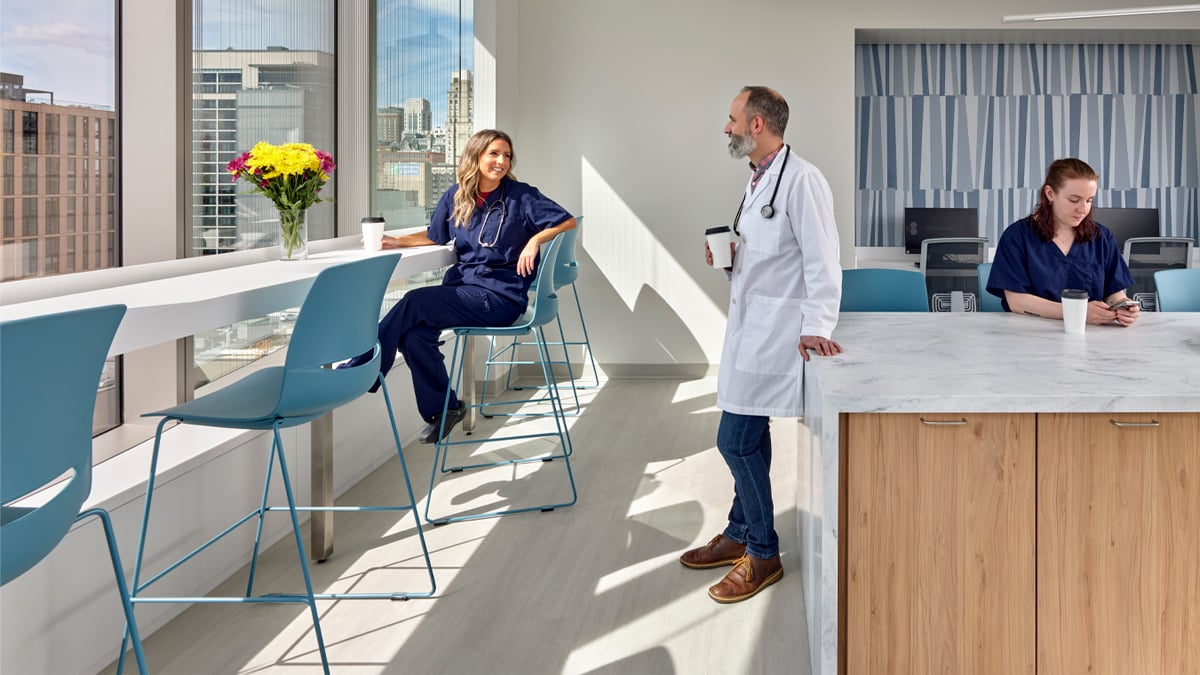 LimeLite High-Density Stack Stool
Flexibility as a Strategic Imperative
If change is constant, flexibility must be foundational.
Fixed layouts struggle to accommodate new technologies, shifting workflows, or evolving patient expectations. Flexible environments, by contrast, create room for adjustment.
Strategies that support future-readiness include modular and reconfigurable spaces, furniture and wall systems that adapt without significant disruption, and multi-use zones that transition throughout the day or week.
These approaches reduce long-term renovation costs and minimize operational downtime. More importantly, they allow healthcare teams to refine processes in real time, improving efficiency and responsiveness without rebuilding from scratch.
Future-ready design acknowledges one constant in healthcare: change itself.


Human-Centered Design
While adaptability and efficiency are essential, future-ready healthcare is ultimately about people.
Patients and families are active participants in care. Environments must support their role with dignity, clarity, and comfort. Human-centered healthcare design prioritizes emotional well-being, family presence without overcrowding, and intuitive wayfinding that reduces stress.
When environments feel welcoming and navigable, they enhance both experience and outcomes.
Clear spatial cues and thoughtful design choices reduce anxiety, support engagement, and strengthen trust between patients and providers.
Future-readiness is not only operational. It is deeply human.


(L) Zoetry lounge chair; (R) Lyra lounge chair
Listening as a Design Strategy
Designing for what’s next requires more than foresight, it requires listening.
KI’s Healthcare Advisory Board serves as a bridge between real-world healthcare challenges and design innovation. It is not a marketing initiative; it is a listening and learning engine that grounds strategy in lived experience.
Through ongoing dialogue, the board helps KI validate assumptions about care environments, identify emerging needs before they become urgent, and pressure-test product and space strategies against clinical realities.
The process is intentional and continuous:
- Insight from the Advisory Board informs deeper market understanding.
- That understanding shapes product and space strategies.
- Those strategies become a roadmap for adaptable, resilient healthcare environments.
This ongoing cycle ensures that future-ready thinking is grounded in lived experience, not speculation.


Continuing the Conversation
Healthcare will continue to evolve. The environments that support it must evolve as well.
To explore how KI partners with healthcare organizations to design adaptable, human-centered spaces, visit our Healthcare page and discover solutions built for resilience and long-term performance.
Stay connected as this series unfolds. Subscribe to the KI Connections healthcare newsletter for ongoing insights from our Healthcare Advisory Board and perspectives shaping the future of care.
The future of healthcare design isn’t a single prediction. It’s a continuous process of listening, learning, and building environments ready for what’s next.