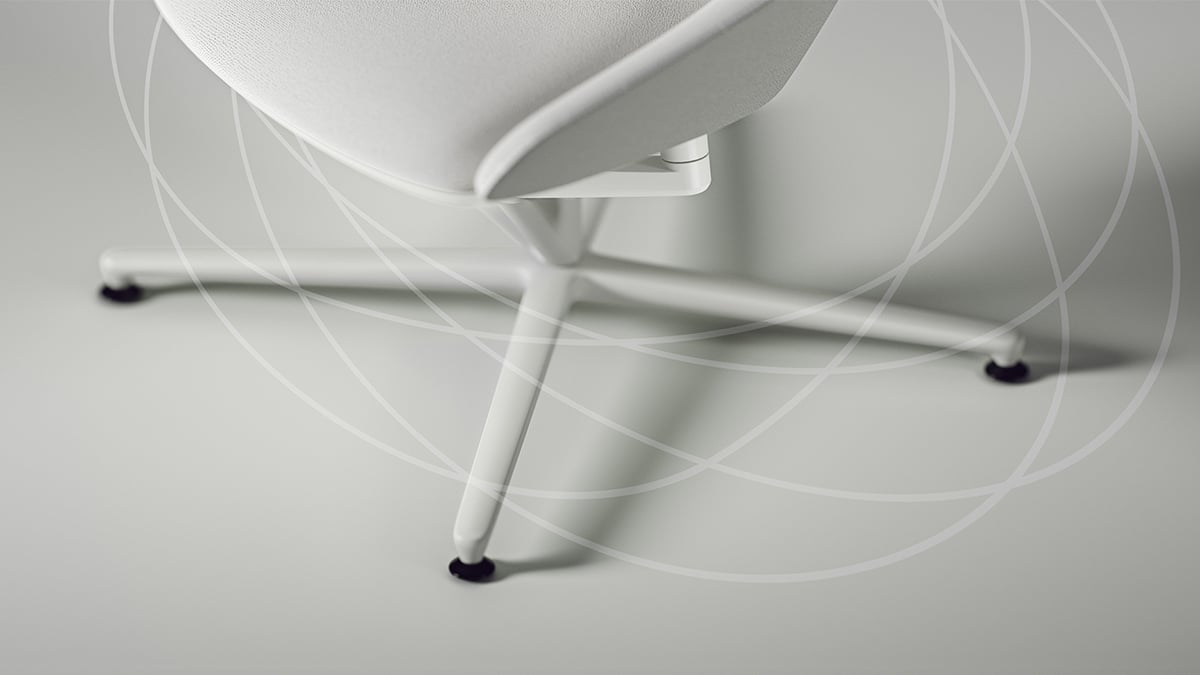
The office furniture industry has spent decades getting better at ergonomics. Lumbar support, seat depth, armrest adjustability, tension control — the list of mechanisms and features designed to make sitting more comfortable is long and impressive. And yet, for all that progress, most chairs are still built around what some believe is an outdated premise: that the human body should remain largely still while seated, and that discomfort is something to be managed rather than prevented.
KI, the Green Bay, Wisc.-based contract furniture maker, thinks the industry has been asking the wrong question for a very long time. And this June during Chicago Design Week, the company is going to make its case for its new seating technology by letting people feel the difference for themselves.
The company will introduce Cognetic Technology during Fulton Market Design Days at its new Inspiration Center in Chicago’s Fulton Market. KI is calling it a breakthrough. That word gets used a lot in this industry, often to describe something that is more evolutionary than revolutionary. This one definitely feels different.
Photos by officeinsight
Here’s the core idea behind Cognetic Technology: Rather than engineering a chair that holds the body in place or asks users to make constant manual adjustments throughout the day, Cognetic Technology is designed to move with the body naturally, responding to the subtle, almost unconscious shifts in weight and posture that happen whenever a person is seated. The technology is built on a patented design that draws on principles of gravity and kinesiology, the science of human movement, to create what KI describes as a sense of balance that feels intuitive and effortless.
KI Research Manager Jonathan Matta said the company has spent three years studying exactly what this technology does to the human body and can point to hard data to back up claims the seating technology is better. Third-party research conducted to validate Cognetic Technology found that users experienced up to a 30% reduction in anxiety while seated, a remarkable finding for a task chair. On the cognitive side, the research showed measurable gains as well. “Users experience increased cognitive performance as defined by visual and auditory recall,” said Matta.
KI claims this chair technology is truly unique and different and a few minutes sitting in the chair and watching others interact with it proves this out. It is difficult to describe how it feels to sit in a chair with Cognetic Technology, now limited to KI’s Klaura Collection, which includes task and lounge seating. Think about traditional task chairs allowing for movement on two planes — up and down and forward and back (if the chair includes a tilt option). Cognetic Technology allows you move your hips forward and back and in a circle.
“What we’re excited about is that we’ve created a new category of human performance,” said Matta during an event in Chicago to show off the technology. “When we look at human performance, we define it by three things: the physical ergonomic component; the physiological or the biology of the body; and then the neurocognitive, the science of the mind. Our research has gone into understanding not just why it’s a better ergonomic chair, but why it’s a better physiological change.”
KI believes the new chair technology reframes the entire conversation around seating. Ergonomics has been the industry’s dominant paradigm for decades; the lens through which virtually every seating innovation has been explained and marketed. Matta argues that Cognetic Technology operates on a different plane entirely.
The KI Flow Chamber allowed the public to test Cognetic Technology™ in the lobby of a busy Chicago office building
“It’s the first The KI Flow Chamber allowed the public to test Cognetic Technology in the lobby of a busy chair designed to turn movement into human performance,” he said.
Tony Besasie, KI’s chief sales and marketing officer, puts the core premise like this: “Our bodies are not meant to stay completely still for hours at a time. Cognetic Technology enables motion through natural micro-movements while seated, helping create a more comfortable and balanced experience that’s better aligned with how the body actually works.”
The origin story of Cognetic Technology is worth knowing, because it says something important about how innovation actually happens. The concept began with designer Aaron DeJule, whose own relationship with seating changed dramatically after a serious car accident left him finding it painful to sit for extended periods. Traditional chairs, despite their many adjustments and ergonomic credentials, offered him little relief. That personal experience led DeJule to a question that sounds simple but turns out to be profound: What if seating worked with the body instead of asking the body to adapt?
Matta describes the development arc as something closer to a personal obsession than a standard product development process that included years of observation, refinement and validation before KI ever got involved. “You have to think of it almost like a tire swing,” he said. “There are videos of his daughter literally on a tire swing in the dining room, and then you can fast forward like four years and it’s finally under the chair itself.”
A peek of Cognetic Technology™ under the seat of a Kiaura task chair
The qualitative evidence gathered along the way has been striking. “We know people say, ‘I can’t go back and sit in my normal chair.’ We’ve had people — chronic back pain always comes up — and how they’ve sat in this for two hours and their back isn’t hurting anymore. We’ve heard that from 20 people in just our office alone,” said Matta.
The industry has spent years debating whether sitting itself is the problem. Matta thinks that misses the point. “Yes, we’re not designed to sit,” he said. “More importantly, we are not designed to be still. What we’ve solved for is removing stillness from the human performance profile.”
The distinction explains why KI has approached the launch the way it has, with an immersive, experience first strategy. In the weeks leading up to Chicago Design Week, the company will host invitation-only previews for designers, media and influencers, including a flow chamber installation designed to let people simply sit and feel the difference for themselves.
KI will also have a presence on the seventh floor at THE MART during NeoCon, allowing them to enter Cognetic Technology into the Best of NeoCon competition.
“This is the kind of shift that changes how you think about sitting,” Besasie said. “We’re using gravity and kinesiology to create a one-of-a-kind experience that is more comfortable and delightful.”
For KI, which is probably best known for its educational furniture, the company hopes the new technology will move it into the conversation as a truly innovative seating manufacturer. The company has committed more research, marketing and sales support to Cognetic Technology than to any product in recent memory. If the research holds up in the market the way it has in the lab and in user testing, it may well be the most consequential thing to come out of Chicago Design Week this June.
By clicking "Accept All Cookies," you agree to the storing of cookies on your device to enhance site navigation, analyze site usage and assist in marketing efforts. For more information, see Website Privacy.